
Happy Birthday, America! I was thinking about what a suitable herb-related topic might be for the United States’ landmark birthday. Some ideas were: red, white, and/or blue herbs; herbs to cool down amidst this oppressive heat wave across much of the country; or maybe even plants that were likely used by our Founding Fathers.
Then, I recently saw an entire article in the Washington Post about – dandelions! This was the second time I’d seen a tribute to dandelions in recent months (more on that in a moment), and then I knew that I had my topic.
What, you say? What do dandelions have to do with America’s 250th birthday? Lots, I say.
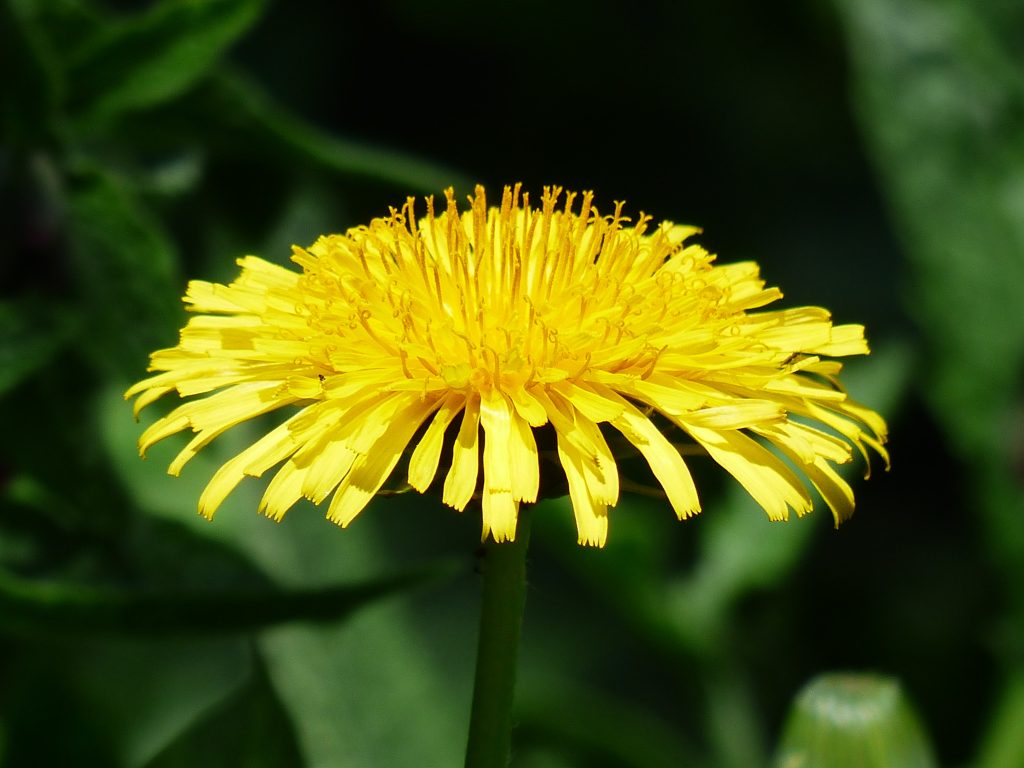
Like most of us (but not all), the humble dandelion (Taraxacum officinale, to be specific) is an immigrant. According to the Washington Post, it was brought over from Europe by early colonists for its nutritional and medicinal qualities1 (more on that later, too!). It easily took to North American climate and terrain – adapting to local conditions and thriving in whatever atmosphere those little fluttery seeds landed on. Indeed, dandelions appear to thrive under just about any conditions, hospitable or not. Soon – within a hundred years or so, anyway – dandelion was firmly embedded in the landscape from sea to (shining?) sea.
Not unlike us Americans.
What’s in a name?
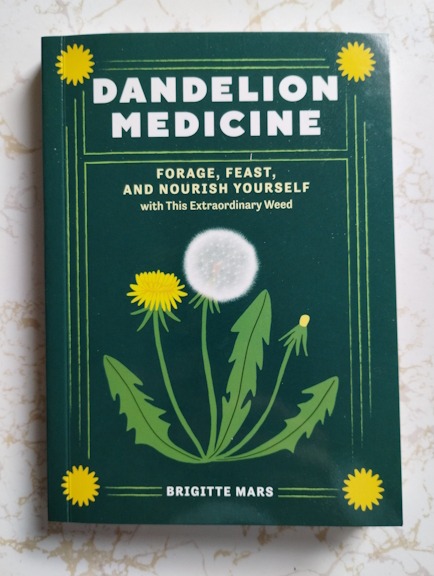
The name ‘dandelion’ derives from a French phrase, ‘dent de lion’, or ‘lion’s teeth’, inspired by the thin, yellow petals of its infamous flowers. My French-Canadian husband informs me that it’s also called ‘piss en lit’, French for ‘wet the bed’. This is due to dandelion’s well-established use as a diuretic. Other names from around the world include ‘radiki’ (Greek, ‘radiating from the center’), ‘talkh chakok’ (Persion, ‘bitter herb’), and p’ogongyong (Korean, ???). Bridgette Mars’ cute little book dedicated to Dandelions, which I found at the retailer Five Below, lists the following amusing common names: blowball, cankerwort, clockflower, monk’s head, swine’s snout, fairy clock, piddly bed, devil’s milkpail, and many others!2
Anatomy of a Dandelion
I can imagine the reason why this unassuming flower in the Asteraceae (daisy) family was a vital import for the colonists. One of the most versatile herbs, the entire plant is used!
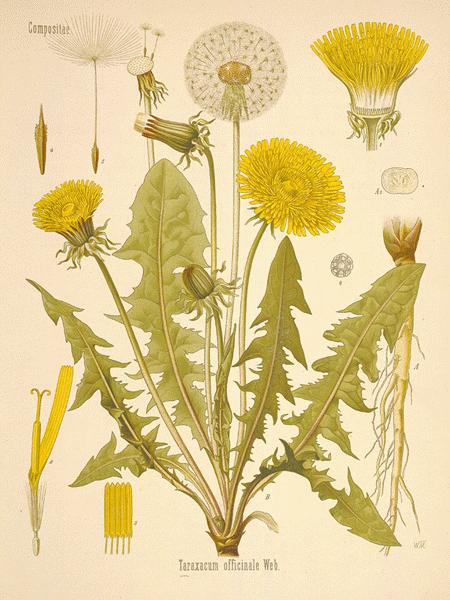
Dandelion normally forms a low rosette of jagged, irregular leaves that survive most winters. In the springtime, the hollow, flower stalk (filled with a milky juice that, frankly, always annoyed me as a kid, ahem) shoots up and opens into a globe-like puff of white, feathery seeds. When I see these in my yard each year I cut them off to prevent the seeds from wind-sowing and spreading. I love me some dandelion, but only in designated locations. Still, I do give credit for an ingenious method of propagating. Who doesn’t love blowing those seeds off the puffballs? Brings out the kid in all of us.
In any case…after the seed-heads mature, they turn into the iconic (infamous?) yellow flower with which we Americans seem to have a love-hate relationship.
Most people don’t think of the root, but dandelion roots are also of interest. Anyone who has tried to dig out a dandelion will note a long, single taproot. This is useful to the soil where dandelion grows because 1. it helps to loosen the soil and 2. it brings nutrients closer to the surface so other plants can benefit.1 To that last point, be mindful of where you harvest dandelions. They are hearty and can adapt to just about anywhere, but do NOT harvest in areas where the soil may be contaminated (roadside, industrial lots, etc) as the plant will take up any toxins.
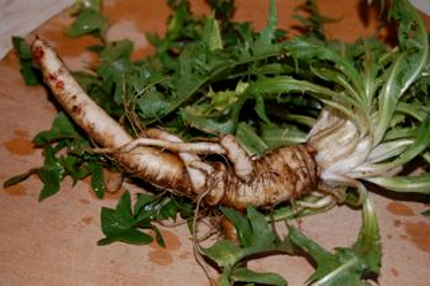
Dandelion Uses
Leaves
Nutritionally, dandelion leaves are good sources of vitamins A, C and K, and contain calcium, iron and magnesium.1 Smaller leaves are wonderful in fresh salads as they add a zesty, slightly bitter taste that pairs well with a light vinaigrette. Larger leaves, sometimes sold in grocery stores, are generally more bitter, and are better suited for blanching or sauteeing.
Medicinally, dandelion leaves are a well-known diuretic. Remember the ‘piss-en-lit’ a few paragraphs ago? Therefore, a tea made from the dried (or fresh) leaves can be used to help flush the urinary system, reduce edema, and possibly manage blood pressure with regular use over time.*
Root
Dandelion is one of the few herbs where different plant parts have slightly different actions. The root, while also mildly diuretic, shines more as a liver tonic. It’s known as a cholagogue, which is a fancy word for “stimulates bile release”, bile being the substance that digests fat. It also stimulates other digestive juices. For this reason, dandelion root is often included in what are known as “digestive bitters”, which are taken before a meal to stimulate healthy digestion. Dandelion root is also a (very) mild laxative, and a good source of inulin, which is a type of starch that functions as a prebiotic to feed and nurture healthy gut bacteria. In general, I use dandelion root for my clients who have digestion and/or elimination challenges. The tea is somewhat bitter, so I usually use it in a tincture format. Alternately, some people enjoy coffee-substitutes that include roasted dandelion root for its hearty, earthy taste. Dandy Blend is one of my favorites.
Flower
Interestingly, dandelion flowers aren’t used much medicinally. I don’t use them at all in my practice, though I’ve heard others do. Topically, dandelion flowers are anti-inflammatory, and the botanical salve I used to treat a bad burn a few years ago contained dandelion flower.
I’ve also seen flowers used for making dandelion wine or infusing into honey or vinegar, though I’ve never tried this, myself. What do you use dandelion flowers for? Let me know!
Wrapping it all up
To be true, I’ve only scratched the surface of the amazing properties of this ubiquitous “weed”. For a whole book-full of fun, useful, and trustworthy information about dandelion, do check out Bridgette Mars’ book.
In the meantime, for America’s 250th birthday I invite you to appreciate how this country was built upon immigrants who came from afar and thrived in so many different geographic regions – just like the humble, adaptable, and persistent dandelion.
- “The surprising ways dandelions are good for us — and our gardens”, Kate Morgan for The Washington Post. 21 June 2026. https://wapo.st/4f14X8t
- Dandelion Medicine: Forage, Feast, and Nourish Yourself with This Extraordinary Weed, Bridgette Mars, RH(AHG), Storey Publishing, 2023
*Please seek guidance from a professional herbalist or medical provider before using herbs in cases of clinical hypertension.