
 Recently I was asked by a fellow Master Gardener for some suggestions on how to put together an ‘educational and fun’ lecture on the History of Herbal Medicine. “Wow”, I thought, “that’s a particularly broad topic”. I started asking her a lot of questions: whose history? Which culture(s)? How far back do you want to go? Unfortunately, I think I overwhelmed her pretty quickly because she really hadn’t thought much past ‘herbal medicine’ as a singular thing.
Coincidentally, it was about this time that a dear friend gave me a book she found from the local used book store: “Polish Herbs, Flowers, & Folk Medicine”, by Sophie Hodorowicz Knab because 1. I’m an herbalist, and, 2. look at my particularly Polish surname! “Wow”, I thought (again!), “that’s pretty specific!”
The timely appearance of this book discussing a single ethnicity’s traditions in using herbs for healing brought the point home to me that there is no single ‘history of herbal medicine’. This appears to be different from other complementary medicine modalities such as acupuncture, which was largely developed in the Chinese culture, or yoga, which sprouted from India. No matter where in the world, every culture used herbs as medicine. Individual herbal traditions evolved with the culture of the people and the plants available to them in their region of the world.
As a result, a strength of today’s “Western herbal medicine” is that we draw from many traditional herbal practices. We survey different cultures, note similarities in herb usages, and compare with what modern science has revealed about these ancient uses.
Whether we are using the Ayurvedic (Indian) herb ashwagandha (Withania somnifera) as a stress-modulator, Chinese white peony (Paeonia lactiflora) to assist with menstrual issues, or plain-old dandelion (which grows EVERYWHERE) for liver health, the result is that we have a large, varied arsenal from which to choose and are not limited to herbs of a single system.
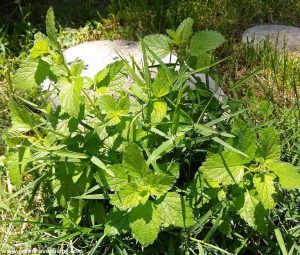
For example, a favorite garden herb that’s native to Europe but has been widely cultivated in North America, lemon balm (Melissa officinalis) has been used for centuries by various cultures around the world. Indeed, herbalist Brigitte Mars, in her book The Desktop Guide to Herbal Medicine (2nd Edition), lists common names for lemon balms in no less than 29 languages. From Arabic (hashisha-al-namal) to Yiddish (melise) and everything in between!